01Arrive before you begin
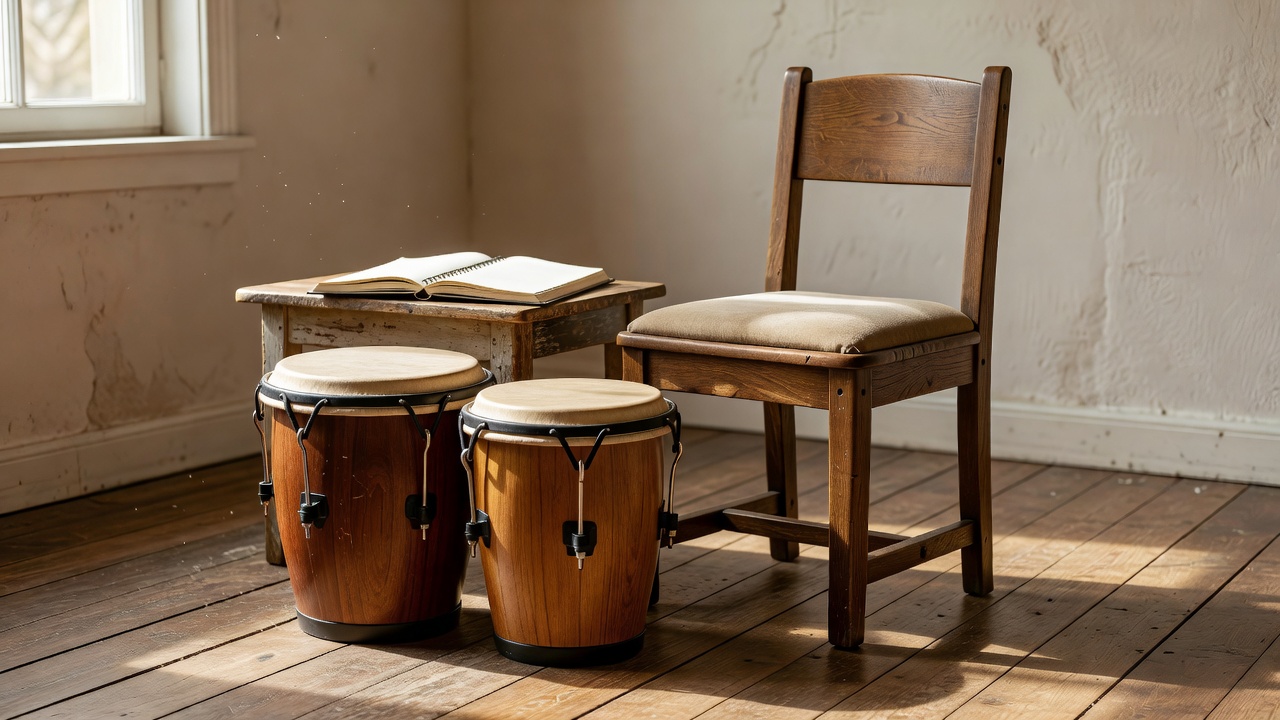
Choose one place to practice and remove anything that makes you reach awkwardly. Put your notebook within easy reach but away from the drumheads. Silence notifications if you can do so safely. Check that your chair and instrument are stable. A calm setup reduces the number of things competing for your attention.
Let both hands rest on your thighs. Notice your shoulders, jaw, and breathing without trying to force a special state. Then listen to the room. Identify one continuous sound and one brief sound. If it is quiet, notice that too. This is a transition into practice, not a test of relaxation.
Choose a focus small enough to describe in one sentence: “I will leave a clear rest,” or “I will let my right hand release easily.” Avoid beginning with “I will become faster.” Speed may eventually be useful, but it can obscure the smaller changes you need to hear and feel as a beginner.
Open the settling checklist
- My instrument is secure and within comfortable reach.
- My shoulders are not deliberately held up.
- I can speak the counts without hurrying.
- I know the one detail I am listening for.
- I will stop if pain, numbness, or tingling appears.
02Find the phrase before the variation
Speak “one, two, three, four” evenly. Next, tap left, right, left, rest on your thighs. Keep the rest as long as each sounding count. If you prefer to lead with the right hand, reverse the hand names throughout. Consistency matters more than copying someone else’s dominant side.
Move to one drumhead and play the same phrase softly. After a few comfortable repetitions, stop completely. Ask whether the pace changed and whether the final rest remained clear. You do not need a perfect answer. A specific observation is enough to guide the next attempt.
Speak it → tap it → play it → pause → notice.
If the phrase falls apart, simplify the task rather than increasing effort. Speak the counts without playing, then add only the first stroke. Restore the other strokes when the counting feels settled. Going back a step is a practical way to reduce complexity, not a penalty.
A metronome is optional. If you already have one, choose a pace that lets your hands stay easy and match one click to each spoken count. Do not keep increasing it simply because the device allows it. If the click becomes distracting, return to your voice and work with a shorter phrase.
03Change one detail, then compare
Choose a variation from your listening notebook. Perhaps a cluster of leaves suggested a softer final note, or a long gap suggested moving the rest. Describe exactly what changes. Keep the rest of the exercise as stable as possible so that the new detail remains audible.
For a first tone variation, move the second stroke to the other drum. Keep the same hands and counts. Alternate between the original version and the changed version, with a silent cycle between them. Listen for which version is easier to remember and which feels less effortful.
Open three possible practice pathways
If you are entirely new: stay with thigh tapping and spoken counts. Finish when you can leave the rest deliberately.
If your phrase is comfortable: compare one-drum and two-drum versions without changing the pace.
If you want a creative prompt: choose one garden observation and make only one corresponding change, then write down your rule.
Do not turn every session into a search for novelty. Repeating yesterday’s easiest version can reveal a clearer release or a steadier pause. Conversely, if you feel frustrated, stop playing and describe the rhythm in words. Musical understanding can develop during a quiet explanation as well as during physical repetition.
04Leave a useful note for tomorrow
Finish with the simplest comfortable version of the phrase. Put your hands down and allow a real pause before evaluating the session. Write one thing you noticed, one adjustment that helped, and one small starting point for next time. Keep your language observational rather than judgmental.
“My second stroke became louder when I lifted my shoulder” gives you something to test. “I have no rhythm” does not. If discomfort occurred, record what you were doing and stop that activity. Persistent or concerning symptoms deserve advice from an appropriately qualified health professional; a written workshop cannot assess an individual injury.
For longer-term learning, a knowledgeable bongo teacher can offer feedback that this page cannot. Trevor Salloum’s The Bongo Book, Ed Uribe’s The Essence of Afro-Cuban Percussion & Drum Set, and Rebeca Mauleón’s Salsa Guidebook for Piano and Ensemble provide different kinds of musical context. They are not interchangeable beginner manuals, so choose material suited to your current question.
Put the instrument away safely, protect it from moisture and direct heat, and leave your note where you can find it. A repeatable session ends with a clear invitation to return—not with exhausted hands or a promise to do everything differently tomorrow.