01Make a steady place to play
Choose a stable chair and set both feet comfortably on the floor. Sit tall enough to breathe easily, without holding your chest rigid. Let your shoulders fall away from your ears. If you notice yourself leaning forward to reach the drum, bring the instrument closer rather than stretching your arms.
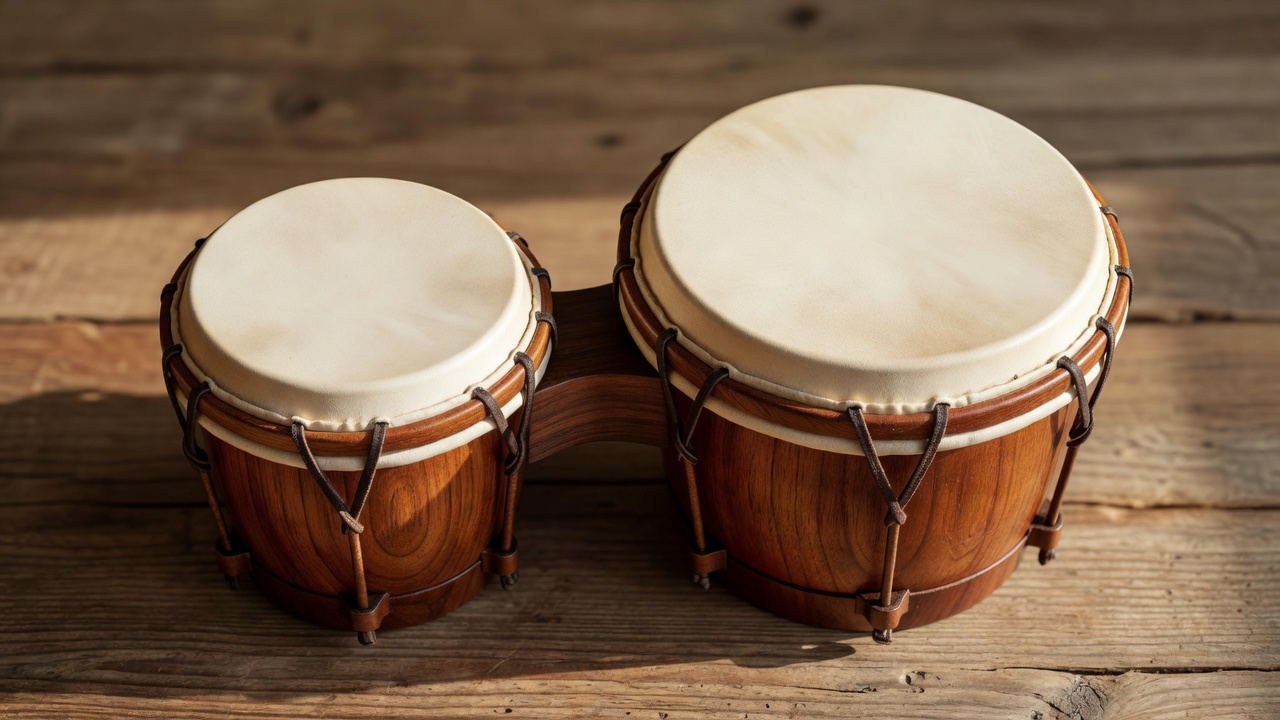
Bongos are a connected pair of drums: the smaller drum is commonly called the macho, and the larger the hembra. Many right-handed players position the smaller drum on their left. Left-handed players may reverse the arrangement. Neither layout should require a twisted wrist. If holding the pair between your legs feels unstable or uncomfortable, use an appropriate bongo stand according to its instructions.
Before playing, check that the instrument is secure and that fittings are not catching your clothing or pressing painfully against your legs. You do not need to adjust tuning hardware for this exercise. If you are unfamiliar with tuning, ask an experienced teacher or consult the maker’s guidance rather than tightening bolts at random.
02Let the hand land and return
Hold one hand above a drumhead with the wrist close to neutral. Keep the fingers softly together, not clenched or stretched apart. For a first light sound, let the comfortable pads of your fingers meet the head near its outer playing area, avoiding a hard collision with the metal rim. Allow the hand to lift away afterward.
The diagram shows an approximate starting area, not an exact target that fits every hand or drum. Move slowly and listen. A small change in where your fingers land can alter the sound. You are looking for an easy contact and release, not maximum volume. A sharper slap is a separate technique; do not force one by striking harder.
Try one stroke with each hand, leaving a generous pause between them. Notice whether you are holding your breath. If so, stop, exhale normally, and begin again more quietly. Pain, tingling, or numbness is a reason to stop, not a sign that your hands need to toughen up.
03Play three sounds and a rest
Say “one, two, three, four” at a comfortable walking pace. Keep all four spaces equally long. Play left on one, right on two, left on three, and no sound on four. Start on one drum so that tone changes do not distract you from the timing.
The rest still takes time. Keep counting rather than jumping straight back to one.
Open the full beginner exercise
- Speak the four counts without playing.
- Tap the phrase gently on your thighs.
- Transfer it to one drumhead, keeping the same easy pace.
- Repeat a few times, then rest your hands completely.
- Try beginning with the opposite hand. Choose whichever version feels less effortful today.
If the loop becomes rushed, return to speaking. A comfortable reset is part of the exercise, not a failure.
Once the phrase is steady, move the second sound to the other drum. Keep the hand sequence unchanged. You have altered the phrase’s color without adding a new timing problem. Write down which version you prefer and why: perhaps the lower response makes the pause easier to hear.
04Keep technique and tradition distinct
This short phrase is an original coordination exercise. It is not martillo, the foundational bongo pattern associated with Cuban son. Bongos belong to Afro-Cuban musical histories, and a garden-inspired lesson should not erase that context. Listening to recordings by Mongo Santamaría, Armando Peraza, and Jack Costanzo can introduce contrasting musical settings, though listening alone does not replace instruction.
For further study, look for specialist teaching resources such as Trevor Salloum’s The Bongo Book and a teacher who can explain both technique and musical function. Congas, timbales, bongos, and the cajón have different construction and playing approaches; advice for one does not automatically transfer to another.
Finish by playing your easiest version once more, quietly. Your useful achievement today is not speed. It is knowing how to sit, how to make an unforced sound, and how to leave a deliberate space.